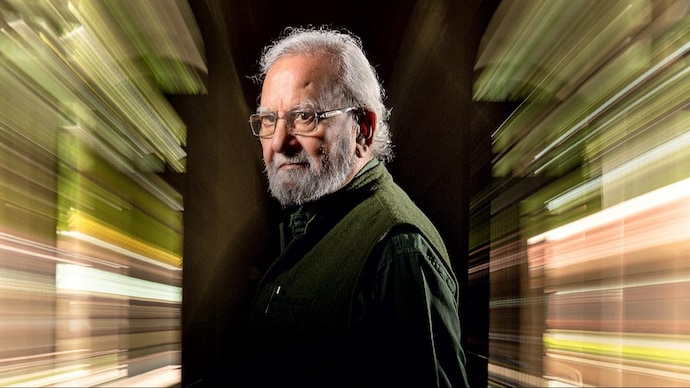
| | |  | | March 1991: The Ramanathan Committee chooses Devanahalli as the site for the airport. | | Jan 1995: A consortium led by Tata is selected to build the airport. | | Dec 1995: The Tata-led consortium quits. | | June 2000: New consortium led by Siemens is chosen. | | Jan 2001: Murthy is appointed as chairman of the Bangalore International Airport Ltd (BIAL). | | Jan 2001: Former PM Vajpayee performs "ground breaking" ceremony (left). | | July 2004: A concession agreement signed by the state Government, the Centre and BIAL. | | Dec 2004: Final clearance given by Dharam Singh Government. | | Jan 2005: The state Government and BIAL sign a land lease agreement.. | | June 2005: SBI gives bank guarantee to the state support of Rs 350 crore. | | October 2005: Murthy quits as BIAL chairman. | | Prima facie, his tirade against the IT industry may sound irrational but Gowda has touched a raw, unstated sentiment in the society. There is a perception that the it sector is getting concessions at the cost of others. On the face of it, it would seem that it companies don't contribute to the exchequer in the same measure that others do as they are not subject to the inverted tax regime that dogs other businesses. Hence, his argument about inequitable distribution of resources-whether it is land for it parks and development centres or moolah from the state kitty for development of urban infrastructure. Policies in modern economies don't evolve purely on revenue considerations. After all, a sector that employs over three lakh people in the state does generate income which is spent in SITU. Home to nearly 1,200 firms and employing nearly two lakh people, the city is choking with tech-laden staff, from the call centre crowd to software developers burning the midnight oil. From pin-striped executives hopping onto planes to young cad cam artists prowling the city's pubs, bowling alleys and food joints, the state earns every time the geeks dip into their hip pocket or log in their credit cards. Bangalore is also more than just another boom city. Whether Gowda likes it or not, it is the acclaimed tech capital of India. The city accounts for 35 per cent of India's software exports, expected to cross $16 billion (Rs 70,000 crore) this year. The high growth rate means that one doesn't get a decent hotel room in Bangalore; some executives stay in Chennai, fly down to the city for business and fly back. "The city has grown too much. The traffic has increased much more than we can bear," says Saurabh Ratan, general manager, Taj Residency, Bangalore. The sector that has nearly a million people feeding off it-from house-keeping and car rentals to security and hotels-is housed in a city nearly crippled by traffic jams. Gowda understands this. More importantly, he understands his politics. Consider this. S.M. Krishna was perhaps the most it-friendly chief minister in the country, yet he yielded ground to Gowda's JD(S) in the previous assembly elections. In neighbouring Andhra Pradesh, N. Chandrababu Naidu and his Telugu Desam Party met with a similar fate despite his government's pro-reforms and pro-it investment image. Having won 59 seats in the Assembly, Gowda understands that a pro-it image might get him accolades among the chatteratti or on Hosur Road, but in the northern rural heartland of Karnataka, it is the pro-farmer stance that gets votes. So even if he felt it necessary to pitch in for urban infrastructure projects, he would feel cagey about doing so. Much like Dharam Singh who is keen to cultivate a rural-friendly image rather than being seen as a city-centric, it-happy chief minister.  | | LAND DEALS |  | | Ground Reality Gowda may be right about the IT firms being offered special deals, but it is not just Karnataka which is laying out the red carpet for them The battle between former prime minister H.D. Deve Gowda and it czar N.R. Narayana Murthy seems to be more and more about land. The main requirement for it and ites businesses, be it a call centre or a software development centre, is indeed space, along with power and connectivity. While Karnataka has been at the forefront in wooing tech investment, other states have not been behind, luring IT firms and ITEs outfits with good deals. Take Punjab and Chandigarh. Both are offering off-the-shelf land deals at subsidised rates to IT majors. Chandigarh is offering plots at Rs 1 crore per acre in its 112-acre Chandigarh Technology Park, at one-sixth the market price for similar property. Infosys has bought 30 acres and invested around Rs 150 crore. Punjab offers land at Rs 40 lakh an acre at Mohali when the market rates hover around Rs 4 crore per acre. It has even earmarked 20-40 acre plots for bigger it players like Wipro and TCS for Rs 35 lakh per acre. In fact, the small it players are now being told to buy built-up area in the 500-acre QuarkCity being developed by the US-based Quark Media. However, officials in both the places say that despite the discount, it companies are choosing Jaipur, Hyderabad and Kolkata because it is cheaper to set shop there.  | | |  | | RAJASTHAN: Duties and taxes for land and building have been waived. Land is allotted at half the market rate. | | PUNJAB: IT companies have been given land at Rs 40 lakh per acre at Mohali when the market price is over Rs 1 crore per acre. | | CHANDIGARH: Land is offered to IT and ITES outfits for Rs 1 crore per acre, a sixth of what it costs others. | | KERALA: A Rs 20,000 subsidy is given for every IT job created. Land is allotted at a third of the market price. | | TAMIL NADU: Land has been given at half the market price to IT and ITES firms. | | ANDHRA PRADESH: Earlier the land was given virtually free. Now, it is auctioned. | | Rajasthan has waived stamp duty on land and building taxes and worked out special packages. For instance, a corporate office for an it major is offered at industrial rates and 20 per cent of the land is allowed for residential purposes. The first five it companies were offered land at half the market price. Kerala and Tamil Nadu too have it-friendly land allotment policies. While Tamil Nadu does allot land at concessional rates, exception is made for some it ventures where land is offered at half the market rate. For some others, land is even offered below the guideline value. The Government sees the pricing as key to attracting more it investment. It has allotted land for an it park which comprises companies like HCL, Infosys and Wipro at the rate of Rs 48 lakh per acre while its value in the open market is twice this amount. Kerala has done better. It gives a subsidy of Rs 20,000 to it firms for each high-value job created. The price of the land given to it firms could be adjusted against the subsidy based on the number of jobs it would create. Gowda may have a point when he argues about equitable distribution of resources for development, but when he rants about wooing it companies he may want to look at what other states are laying out. Bureau reports | | Gowda is not just cagey, he sees the IT sector as a usurper. Besides, he is shooting for the next polls. Having tasted power after a hiatus when he was written off, Gowda sees capturing power in Karnataka as the first step to a repeat of the 1997 miracle when he was sworn in as prime minister. So his first target is to consolidate votes-which translates into a pro-farmer (and hence an anti-urban) stance, and to keep his bete noire Krishna off the state political radar. So when he suggested that Murthy was probably batting for sections outside the state, namely Krishna, the aim was to widen the rift within the Congress. Krishna's recent remarks on his desire to leave the Raj Bhavan in Mumbai and return to active politics hold a threat for Dharam Singh. It doesn't help matters that Krishna is perhaps the only Vokkaliga leader who could counter the former prime minister. "Gowda is not keen to have Krishna in Karnataka," says former urban development minister, Krishna acolyte and Vokkaliga leader D.K. Shivakumar, who was kept out of the Karnataka cabinet at Gowda's instance. Gowda, of course, sees himself as the sole arbiter and protector of Vokkaligas, who account for 16 per cent of the votes.  | | ROAD CONNECTIVITY NETWORK DOWN | |  | | The airport road flyover project, costing Rs 26 crore, which began in February 2003, should have been ready in April 2004. Now it is expected to be completed by January 2006. | | An elevated, four-lane, 9 km long motorway along Hosur Road leading to Electronic City was supposed to begin on April 2005. Feasibility study for the Rs 360 crore project is not yet done. | | The Magadi Road-Chord Road flyover was to be ready by December 2004. It will be completed only by June 2006. | | The Rs 165 crore plan for the development of Old City still remains on paper. | | Plans for a 131 km long peripheral ring road, critical to decongesting Bangalore, are ready. However, land acquisition hasn't even started. | | The Bangalore Metro project should have been ready by 2003 but there is no sign of construction yet. The cost has gone up from Rs 4,900 crore to Rs 6,000 crore. | | A Rs 280 crore project to develop 270 km of new roads has stumbled on a block. The roads should have been constructed in 2003. | | In fact, he said as much, "I don't want people to think that I am anti-it. I am against it the way it is practised by a gentleman who is trying to make a comeback in active politics." In a sense, his vicious personal attack against Murthy is not surprising because he sees the Infosys chief as a proxy being used to destabilise the carefully crafted coalition. Gowda also uses comparisons with good effect. Citing several psus, Gowda asked why it too couldn't work for the society. "Don't get taken in by it," he said. "PSUs like HAL, ITI, BEL and ISRO are working quietly in Bangalore and have contributed enormously to the society. They are not making such a hue and cry. All we are saying is that it should benefit the common man, the farmers, the poor. We have done so much for them, including providing tax holidays," he added. Krishna, who has been meeting IT entrepreneurs during his visits to the state, was in Bangalore during the Murthy-Gowda eruption. He indirectly hit out at Gowda and Dharam Singh for not extending support to the IT sector as he had done. The former chief minister did indeed have performing bureaucrats like Jayakar Jerome-currently his secretary in Raj Bhavan-who single-handedly changed the Bangalore Development Authority from a dead agency to a cash-rich cow and completed several landmark projects. Krishna had also set up the Bangalore Agenda Task Force (BATF), a private-public partnership to improve the city's infrastructure, including roads and civic amenities. It is another matter that Dharam Singh did away with BATF because of the Krishna link. If Gowda wants to exorcise the current coalition government of Krishna's influence, Dharam Singh is willing to do the same. Even when a miffed Murthy resigned as chairman of the BIAL, Dharam Singh was not too keen to have him reconsider the decision. It was only when concerns were raised in the state and at the Centre that he called up Murthy in America and requested him to retain the post. In some ways, Bangalore's current state offers Krishna a window of opportunity. "My idea was to let the citizens be a part of the management process but this Government does not think it important and the city is left to suffer," he says, taking pot-shots at Gowda. Krishna's statements have only fuelled the imbroglio and given Gowda a handle to campaign for his cause. He is using every weapon in his armour. When the city was reeling under heavy rains and floods and people wondered about the lack of amenities during the crisis, Gowda had the scapegoat ready: "The it people have crowded the city and the past government was obsessed only with this sector." The truth is that Bangalore was a boom city in the 1980s before it became the buzz. Index |